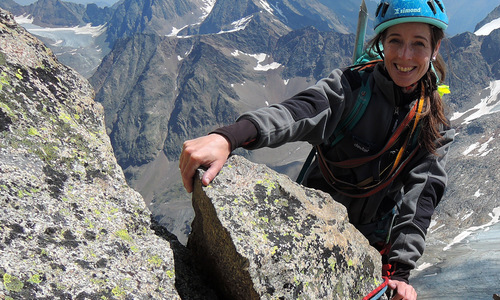
15 routes of varying difficulty take you through rugged mountain ranges of limestone and crystalline granite rock faces. At the summit you are rewarded with unimaginable views of the glacier valley that continue to inspire and delight beginners and advanced climbers alike.
The Stubai Valley is known for its high level of mountain expertise. This can be proved firstly by historic reports of the first known alpinists who explored the mountains of the Stubai valley early on. This reputation is further contributed to by the villages rich in traditions that arose from the mining industry and which are still known for producing first-class mountain sports equipment, along with the local mountain guides and mountain hut landlords. The basis for all of this are the different types of rocks which have opened up numerous possibilities – from vie ferrate routes to sport climbing routes – and which have made the Stubai Valley into one of the most varied climbing areas in Tyrol.
Hotspots for climbers
The Kalkkögel group in the Schlick 2000 hiking centre offer the possibility to gather your first climbing route experiences in the Kreuzjoch alpine park or explore the rocky landscape on the Ochsenwand via ferrata. This challenging climb was built in 1985 and illustrates the trend back then toward long and difficult climbing routes. Anyone who finds the large Ochsenwand too small can connect to, or add on a second, moderate difficulty climb on the Steingrubenkogel.
One of the oldest via ferrata in the Stubai Valley can be found in the Elferlifte region in Neustift. On the local Neustift mountain the Elferkofel route travels along the rocky crest of the Elfer peak. It offers plenty of steep and breezy passages, as well as breath-taking views of the peaks of the Pinnis Valley, among which there is the Ilmspitze, which also has a via ferrata route. You have the option to combine two routes here too: the Elferkotel route with the classic route of the Elfer Nordwand.
Over the years the area around the Stubai Glacier cableway middle station, above the Dresdner Hütte, has developed into one of the most popular places for climbing enthusiasts. The Fernau and Fernau Express fixed rope routes – one of the most difficult via ferrata route in Austria – lure mountain-lovers up to new heights. The sunny climbing park is also a playground for beginners who can gain their first mountain experiences on the three short practice climbing walls, and free climbers will be rewarded with great views on one of the nine sport climbing routes with rock offering good grip.
Huts complement the climbing experience
Some of the huts situated higher in the Stubai Valley are not only starting points or rest places on extended mountain tours, but offer additional opportunities to explore the diversity of the mountains with short and exciting climbing routes. Just ten minutes from the Nürnberger Hütte there is a beautiful and enjoyable ferrata in a small climbing crag. More fixed rope routes near huts have been set up at the Innsbrucker Hütte, the Franz-Senn-Hütte or the Sulzenauhütte. Among these are very adventurous routes such as the practice via ferrata route WildeWasser near the Sulzenauhütte, which goes over a mountain stream and can be combined with a Flying Fox or the Höllenrachen route at the Franz-Senn-Hütte, which even goes partially underground as it skims over the surface of a stream.
Safety on the rock face
Even though vie ferrate routes are secured with wire ropes and iron foot and hand holds, and you find yourself in a supposedly safe environment, you should always have an experienced mountain guide with you if you are a beginner. Competent Stubai Valley mountain guides will gladly provide you with important information and tips on correct and safe ascent using climbing routes. They can also supply you with the correct equipment. Other requirements are a certain level of physical fitness, and above all, no fear of heights.
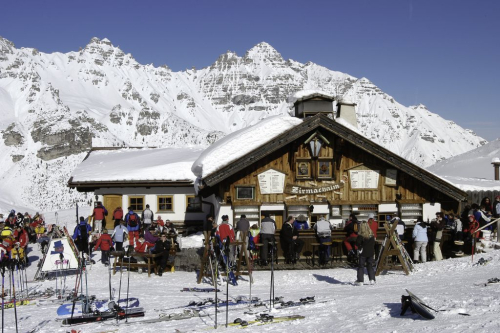
Great Alpine valley
The Stubai Valley is located near Tyrol's provincial capital Innsbruck, and it can be easily reached from Germany, Austria, Switzerland and Italy. The Stubai Valley is 35 km long and surrounded by 80 glaciers and 109 three-thousand metre peaks; its five main centres are Neustift, Fulpmes, Telfes, Mieders and Schönberg. The valley’s all-year-round programme is especially well-suited to anyone seeking an active holiday: The Stubai Glacier, the largest glacier ski area in Austria, offers the finest conditions for skiing well into the summer. Great summer activities and an excellent network of cabins and paths await holidaymakers in the Schlick 2000 hiking centre in Fulpmes, the Serles hiking area in Mieders and at the Elfer lifts in Neustift. Hiking, climbing, mountain biking, paragliding on outstanding thermals, Nordic walking, tennis yoga, swimming and many other types of sport lure visitors in the summer.
One five-star hotel, two four-star-plus hotels, 32 four-star hotels, 2 three-star-superior hotels, 28 three-star hotels of a high standard and around 4,700 beds in holiday apartments and bed and breakfasts as well as traditional farmhouses and three camping sites all offer comfortable accommodation to suit every taste.
The Stubai Super Card, which guests receive automatically when they check in to participating establishments between May and October, has numerous advantages such as free travel on buses, the Stubai Valley Train and cable cars, in addition to free entry to swimming pools in Neustift and Mieders.
INFO: Stubai.at
 VIDEO
VIDEO FACEBOOK
 TWITTER
 INSTAGRAM
 PINTEREST
 ENGLISH